
Rorbu in Norway
Search for a rorbu and you will almost certainly end up in Lofoten. Here is what the word actually means, what to check before you rent by the water anywhere in Norway — and what you get with us, on a coast most people have never heard of.
Updated August 2026.
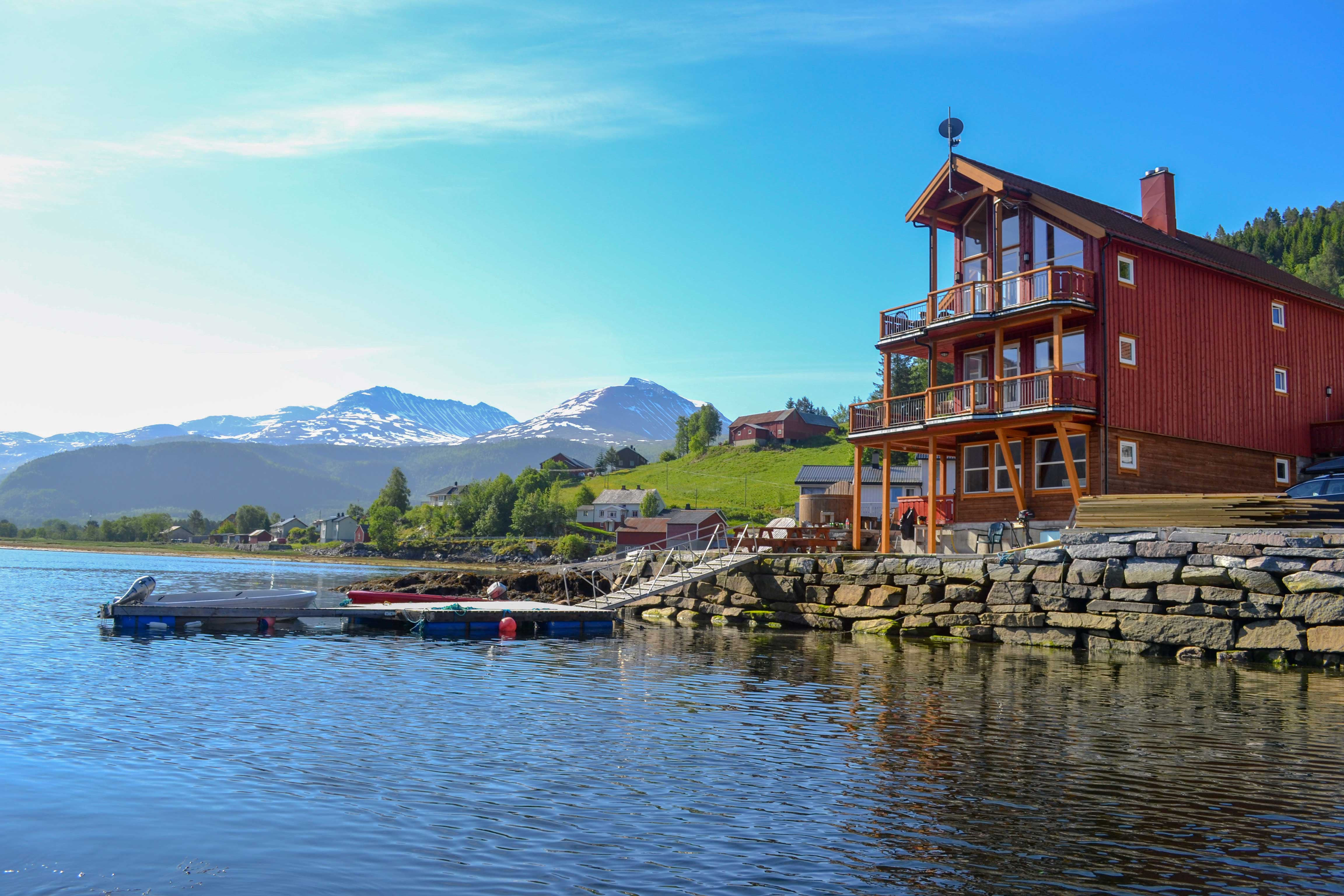
We rent these out ourselves. Todalen Brygge is our own place, so read this with that in mind. Which is why we say so where the industry's use of language — ours included — is looser than it should be.
What a rorbu actually is
A rorbu was originally a seasonal shelter for fishermen: a simple cabin on poles at the water's edge, used for the few weeks the fishery lasted, and empty the rest of the year. The word belongs to the history of dried cod, which is why most genuine, restored rorbuer stand in Lofoten and Vesterålen, in the far north.
Today the word is used far more loosely. «Rorbu» has become a marketing term for more or less any accommodation near the sea — from authentic nineteenth-century fishermen's cabins to newly built apartments with a jetty outside.
We call ours rorbu apartments, not rorbuer. They are modern apartments at the water's edge in Todalsøra, not restored fishermen's cabins. If you want the original — sloping floors and history in the walls — go north to Lofoten, and we would rather tell you that now than have you work it out on arrival.
Where Nordmøre is, and how you get here
This is the part a Norwegian reader does not need. Nordmøre is the northern part of Møre og Romsdal county, on the west coast, roughly between the towns of Molde and Kristiansund to the south-west and Trondheim to the north-east. It is fjord country: deep water, steep sides, and mountains that start where the road ends.
Todalen Brygge sits at Todalsøra, at the head of the Todalsfjord in Surnadal municipality. The nearest airports are Kristiansund and Molde; Trondheim is the largest airport within reasonable driving distance. You will want a car. There is no useful public transport to a jetty at the end of a fjord, and the things worth driving to out here are spread out.
Two practical Norwegian habits that surprise visitors. Toll roads and most ferries are unmanned and camera-based: you do not stop and you do not pay at the barrier, and the charge finds its way to the vehicle's owner afterwards — if you are in a hire car, ask the rental company how they pass it on, because they all do it differently. And card payment works essentially everywhere, including on ferries and in the smallest shop; you do not need Norwegian cash.
Why you find so little for Nordmøre
It is not that there is nothing here. It is that the word «rorbu» is tightly bound to Lofoten in everything written online, and that the people renting out on Nordmøre are mostly small: a family with two or three units rarely advertises widely enough to compete with a destination that has marketed itself for decades.
In practice that means two things for you. You have to search more deliberately — use place names (Todalen, Surnadal, Tustna, Halsa, Tingvoll) rather than «rorbu». And you meet far less competition for dates: nothing here is sold out six months ahead.
Five things to check before you book by the water
1. Distance to the water, in metres
«Sea view» can mean two hundred metres and a county road in between. Ask how many metres it is from the door to the waterline, and whether you cross a road on the way down. That single question separates the listings more than any other.
2. Is a boat included — and do you need a licence?
This one catches foreign visitors out. In Norway, anyone born on or after 1 January 1980 needs a boating licence (båtførerbevis) to drive a recreational boat that is over 8 metres long or has an engine over 25 hp. Below both of those thresholds, no licence is required regardless of your age.
All our boats are well under 8 metres, so the deciding factor is engine power — ask us before you book, and bring your licence if you have one. A foreign certificate is generally recognised, so do not leave it at home on the assumption that it will not count. Also ask, wherever you rent: is the boat hired from the same place you sleep, are life jackets included, and is there an echo sounder if you plan to fish.
The rule and its thresholds are set out by the Norwegian Maritime Authority (Sjøfartsdirektoratet) in the regulation on minimum age and boating licences for recreational craft.
3. Kitchen and washing machine
On a week with children, a washing machine is worth more than an extra few square metres. Check whether the kitchen has an oven and not just a hob, and whether there is a dishwasher — that detail is rarely in the headline.
4. What the season actually does to the price
Almost everyone has seasonal pricing, but few show it before you have chosen your dates. Ask for the total price for the whole stay, not the price per night. And ask whether there is a weekly discount — it is common, but it does not always apply itself.
One more thing worth stating plainly, because it is the question every foreign guest asks: Norwegian holiday apartments are normally priced per apartment per night, not per person. Ours are. Four people in an apartment pay what one person pays.
5. Weather, season and daylight
This is not the Mediterranean, and the light matters as much as the temperature. June to August is the safest bet for swimming and long evenings — in midsummer it barely gets properly dark. May and September give you a still fjord and almost no people. From October it is dark early. None of that is bad, but it is a different holiday, and you should choose it knowingly.
Things Norwegians forget to mention
- Tap water is excellent everywhere in Norway. Do not buy bottled water; nobody here does.
- Shops close early by continental standards, and on Sundays the ordinary grocery shops are shut. Plan the first evening's food before you arrive.
- Midges can be a nuisance on still, warm evenings in high summer, mostly near fresh water and mostly at dusk. Bring repellent if that bothers you; it is a nuisance, not a plague.
- Mobile coverage is good in the valley and along the fjord, and unreliable once you are properly into the mountains.
- The weather changes fast. A wet morning here is not a wet day, and a plan that depends on one specific sunny afternoon is a plan that will disappoint you.
What it costs with us
Our rates are temporarily off the site while we get the season ready. Send us your dates and you will get a price for exactly those by email — ask about a stay. If you would rather call or write, it is +47 995 85 098 and halle@vedhavogfjell.no.
Planning to take fish home with you? Norway's rules on exporting your catch have changed in recent years, and how much you may take out depends on the provider you fished through being registered for it. Ask us before you book rather than after — the worst day to find this out is the day you leave.
When should you come?
If you want to swim and be out on the fjord in shirtsleeves, July and the first half of August is the answer — and that is also when it is most expensive and busiest. If you want the fjord to yourself, late May and all of September are underrated: light enough for long days, cool enough that the midges have given up, and low-season prices.
If the mountains are the reason you are coming, July to September is the dependable window — more about hiking Trollheimen here.
Questions before you decide? Call +47 995 85 098 or write to halle@vedhavogfjell.no. We answer honestly, including when the answer is that the week you are asking about is the wrong week.